
St. Louis County 72-Hour Releases
There is no Sheriff-issued St. Louis County 72-hour release list. The official recent-release product covers about 48 hours and carries an hourly report timestamp. A full three-day review therefore has two parts: read the county PDF for the newest portion, then use MCRO, jail confirmation, or a data request for the older 24 hours.
This division is important. A regenerated PDF is not an archive. Once a row falls beyond the report window, a later visit to the same URL cannot recover the prior display. The row's absence says nothing about whether the underlying booking or release record still exists.
The official roster landing page is shown below.
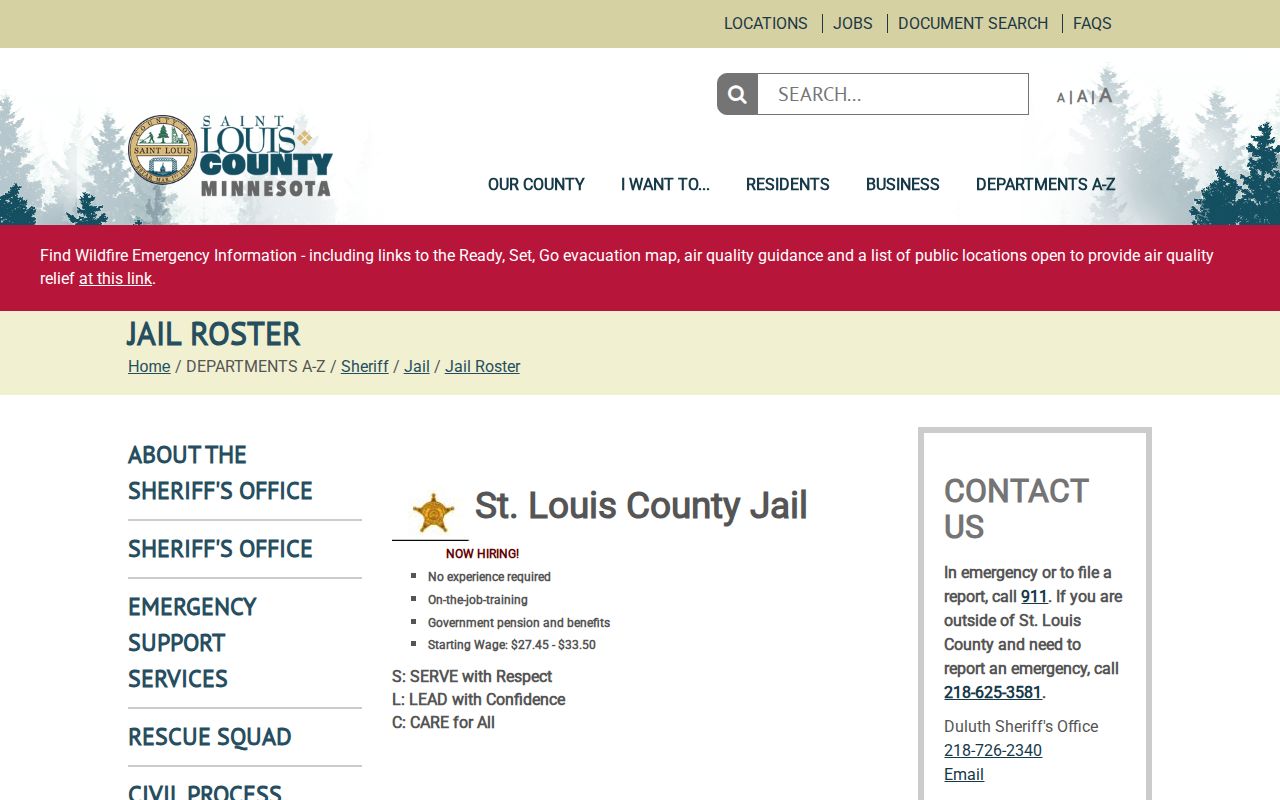
The image shows why readers must choose View 48 hour Release Roster rather than the current population report.
Build a St. Louis County Window
Set the interval from the current report timestamp, not from the start of a calendar date. Then work backward. The newest 48 hours can be searched in the PDF. The prior 24 hours need a durable source, since they have already rolled away.
- Open the official 48 hour Release Roster and record its “as of” time.
- Search the PDF by surname, then compare jail number, birth data, booking time, location, and arresting agency.
- Save each Released Date within the report and identify the earlier 24-hour gap.
- Search MCRO for the likely St. Louis County criminal case and release-related court event.
- If the docket is incomplete or remote name search is blocked, contact the jail or request existing release and transfer data from Central Records.
MCRO may restrict remote defendant-name search for a pending matter without a conviction. Dismissed and continued-for-dismissal matters can remain within that restriction. Search by case number or citation when known. A courthouse terminal or Court Administration counter can provide a stronger path when remote access is too narrow.
The same-day filtering method is explained separately on Jail Releases: 24 Hours.
St. Louis County Release List Fields
The official report supplies detailed identity, booking, and release-time data for its rolling window. It does not tell the whole story. Match the row first, then seek the legal basis in a companion record.
| Field | What it shows |
|---|---|
| Name and jail number | Person and local custody identifier |
| DOB when public and age | Added identity comparison |
| Booking date and time | When the listed booking began |
| Released Date and time | When that Sheriff booking ended |
| Location | The booking location, which can name an outside facility |
| Bail and arresting agency | Context, not a release-reason statement |
| Charge, level, and order type | Listed matter and custody basis, not the final judgment |
The PDF does not include a booking photo, release destination, supervising office, final disposition, or normalized reason. An entry can prove that the local booking ended without proving that the person entered the community. A Sheriff transfer record answers that question when another authority took custody.
St. Louis County Weekend Releases
A three-day interval is useful after a weekend or a missed daily check because it reaches farther back than a same-day view. The county has not published a standard weekend release schedule. Do not infer a release hour from court hours, the PDF refresh, or the two Range lockups' names.
The report updates hourly but is not promised to post an event the moment the door opens. Note both the report time and release time. If a release occurred near the edge of the official window, save the row while visible and confirm it through the Sheriff or court record.
Holidays can also make court-counter access less immediate. Remote MCRO may still be available, but an online register description is not always the full signed order. Use the case location in Duluth, Hibbing, or Virginia when a terminal or certified copy is needed.
Note: The county publishes no standard weekend jail-release hour, so the report and agency record control each individual event.
Recover Older St. Louis County Releases
For hours 49 through 72, first look for the legal event in Minnesota Court Records Online. Search the likely criminal case and review the register of actions, dispositions, release conditions, sentence, and later events. A court order can explain why release was authorized, while the Sheriff record supplies the physical date and time.
For direct proof, use the Sheriff's public-data request channel. Give the full name, date of birth if known, jail number, and approximate booking and release dates. Ask for adult arrest or booking data showing the date, time, and legal basis of release. If a transfer is possible, separately ask for the recipient, time, and legal basis.
St. Louis County Sheriff Central Records100 North Fifth Avenue West, Room 103
Duluth, MN 55802
218-726-2340
DSO.Records@StLouisCountyMN.gov
Inspection of public data is free under Minnesota law. Copy charges may apply. The Sheriff has no published flat release-record fee or guaranteed response time, so request an estimate. If data are withheld, the agency must cite the legal authority for denial.
Under Minn. Stat. §13.82, adult release data include the date, time, and legal basis. Transfer data separately identify the recipient agency, date, time, and basis. That wording helps staff locate the existing record and prevents a local booking end from being described as freedom when custody moved elsewhere. Request only the date range and booking at issue. A focused request is also less likely to confuse people who share a name.
Check St. Louis County Custody
The current jail roster and release report answer opposite questions. The current roster concerns an active booking. The release report concerns a recently ended booking. A person can leave the first without entering the second right away because processing and report refreshes take time.
| Clue | Meaning | Next check |
|---|---|---|
| On current roster | Current Sheriff booking | Read Location and contact that facility |
| On release roster | Local booking ended | Check court order or transfer record |
| Absent from both | Unknown without more facts | Test intake lag, rollover, transfer, or another system |
| Under Supervision in DOC | Left state prison but DOC jurisdiction continues | Read DOC profile and court case |
| Not in BOP custody | Federal BOP custody ended | Check federal docket and other authorities |
A missing name proves none of release, transfer, innocence, or non-arrest. St. Louis County uses other jails to relieve crowding. The live roster's Location may identify Pine County, Carlton County, Douglas County Wisconsin, or another facility. Contact the named location.
St. Louis County Release Fallbacks
Minnesota VINE provides alerts for participating county-jail bookings. It can help with a future release or custody change, but the alert is operational notice, not a certified historical release document. State-prison notification belongs to Minnesota Haven. MN DOC Public Viewer covers adults still under DOC jurisdiction, including some people released to supervision.
Federal Prison Camp Duluth is a BOP facility, so its release dates do not appear in the Sheriff PDF. A U.S. Marshals pretrial person may be housed in a contract jail and requires the federal docket plus holding-facility confirmation. An ICE handoff is also a transfer, not community release. Use the ICE locator only after the receiving authority points there.
These channels should not be blended. The county report proves a Sheriff booking ended. DOC, BOP, ICE, VINE, and court records each describe a separate role. The named-person decision tree is available on the St. Louis County released inmates home page.
For a county-jail alert, Minnesota VINE may update more often than the hourly PDF because the state fact sheet describes typical jail-feed intervals of 15 or 30 minutes. It is still not instant, and each participating agency supplies its own data. A general release, court-order release, bond release, transfer, escape, or record purge can trigger different messages. Read the exact event and then obtain the originating record when durable proof is needed.
St. Louis County Release Rollover
St. Louis County's distinctive data quirk is its precise 48-hour PDF. It gives exact release times, charges, and location. It has no standard reason or image. That mix makes it strong evidence of a recent local exit but weak evidence of what came next.
Once the row rolls over, Central Records and MCRO are the continuation paths. No official Sheriff release-search app was found. The county website and PDF remain the authoritative mobile-accessible sources. The Hibbing and Virginia “72 hour lockup” label describes those short-term facilities, not the length of any public release list.
The county jail overview is the source of that lockup description. Hibbing and Virginia are short-term custody points, while Duluth is the main booking and processing jail. A move from a Range lockup to Duluth can end one location's stay without creating a community release. Check the county-wide roster, location, and Sheriff confirmation.